
How To Challenge Unhelpful Thoughts
Sep 15, 2026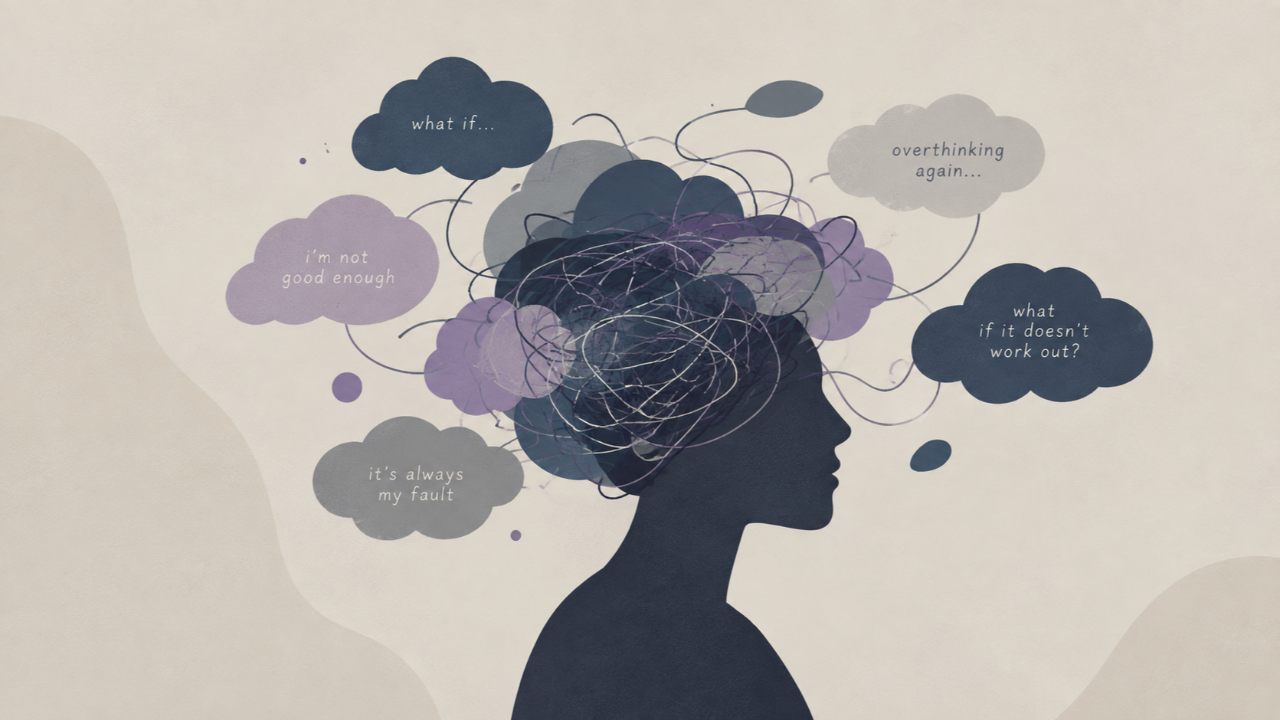
You mess up one task at work and immediately think, "I'm going to get fired." Your partner is quiet over dinner and you're suddenly convinced they're pulling away from you. The thought arrives fast, feels completely true, and before you've even questioned it, you're already reacting to it.
Here's the part that's easy to forget in that moment: a thought is not the same thing as a fact. It's your mind's best guess, built quickly and often shaped more by fear or past experience than by what's actually happening in front of you. And guesses can be challenged.
Why Challenging a Thought Actually Works
You can't always control which thoughts show up; they tend to arrive uninvited. But you do have a say in what happens next: whether you believe the thought automatically, or pause to check if it's actually holding up.
This isn't about talking yourself out of every worry or forcing yourself to feel a certain way. It's about slowing down long enough to separate what you know from what you're assuming, because most unhelpful thoughts fall apart, at least a little, the moment you actually look at them closely.
A Simple Way to Challenge a Thought
Try walking through these questions the next time a thought feels overwhelming or hard to shake:
- What's the thought, exactly? Put it into words, as specifically as you can. Not "I feel awful," but the actual sentence running through your head: "I'm going to get fired," "they don't care about me," "I always ruin things." Naming it precisely makes it much easier to examine.
- What do I actually know, versus what am I assuming? Separate fact from interpretation. "I made a mistake in the report" is a fact. "I'm going to get fired for it" is an assumption stacked on top. Most unhelpful thoughts are built this way: one small fact, followed by a much bigger story.
- What would I say to someone I care about, in this exact situation? This question works because we're often far more understanding with other people than we are with ourselves. If a friend told you they made one mistake at work, you probably wouldn't jump straight to "you're getting fired"; you'd likely offer them a more reasonable read of the situation. Try offering yourself the same one.
- What else could explain this? Your mind usually lands on one explanation, and it's rarely the only one. If a friend didn't reply to your message, it could mean they're upset, or it could mean they're busy, their phone died, or they simply haven't seen it yet. List two or three alternatives before deciding which one is actually most likely.
- Has this thought shown up before? If a similar thought keeps recurring in similar situations, that's useful information. It usually means this isn't really about the specific moment in front of you; it's a pattern worth noticing and, over time, working through.
This Gets Easier With Practice
The first few times you try this, it can feel slow or even a little mechanical, like you're interrupting a thought mid-sentence to interrogate it. That's normal. Over time, the process gets faster, and eventually some of it starts happening automatically, before the thought has a chance to fully take hold.
Some thoughts will still be hard to shake, even after working through all of this, and that's worth paying attention to, not pushing past. Deeply rooted patterns often need more than a self-check-in to really shift.
When You Need More Than a Technique
If certain thoughts keep circling back no matter how many times you challenge them, that's usually a sign they're tied to something deeper: an old experience, a long-held belief about yourself, or a pattern that started long before the situation in front of you today. That kind of work is hard to do fully alone, and it's exactly what therapy is for.
If this sounds like where you are right now, we'd be glad to help you work through it.
Stay connected with news and updates!
Join our mailing list to receive the latest news and updates from our team.
Don't worry, your information will not be shared.
We hate SPAM. We will never sell your information, for any reason.